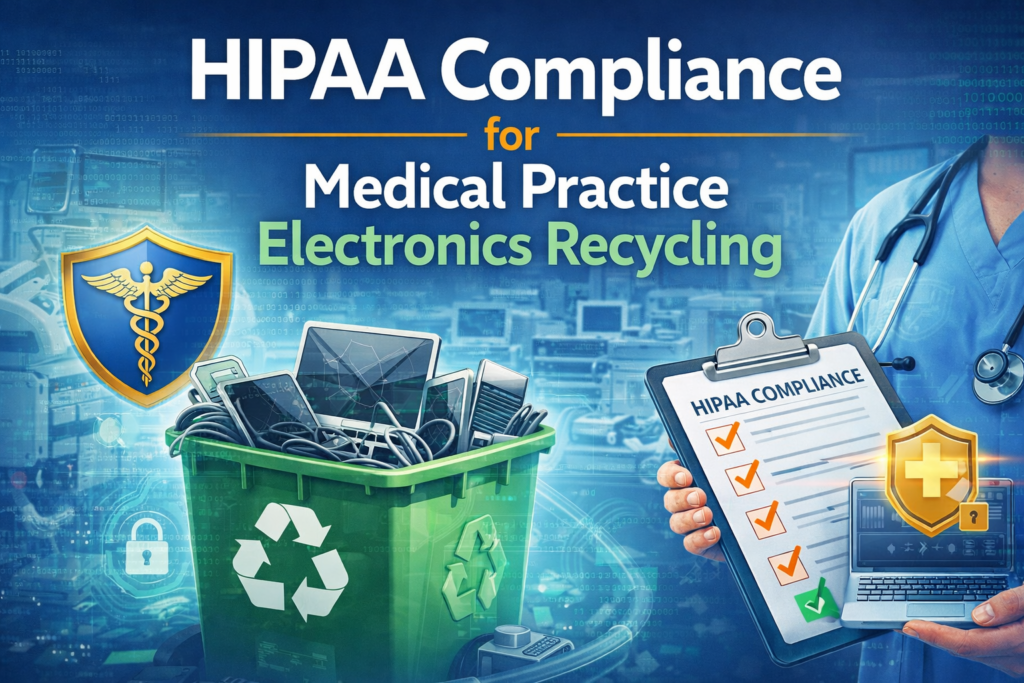
Medical practices in Dallas–Fort Worth handle some of the most sensitive information that exists: patient health records. When computers, servers, printers, and other electronics reach the end of their useful life, disposing of them properly is not just good practice. It is a legal requirement under federal HIPAA regulations.
This guide explains HIPAA compliance requirements for electronics recycling, what Dallas medical practices must do to meet these standards, and how proper disposal protects both patients and healthcare providers.
Understanding HIPAA and Protected Health Information
HIPAA stands for the Health Insurance Portability and Accountability Act. This federal law establishes strict rules for how healthcare providers, insurance companies, and their business partners must protect patient information.
What Counts as Protected Health Information
Protected Health Information, or PHI, includes any information that can identify a patient and relates to their health condition, treatment, or payment for healthcare services. This encompasses:
- Patient names, addresses, and contact information
- Social Security numbers and medical record numbers
- Dates of birth and dates of service
- Diagnosis codes and treatment information
- Insurance information and billing records
- Lab results and prescription records
- Appointment schedules and clinical notes
- Email communications between patients and providers
Essentially, if your medical practice electronics have ever been used to access, store, or transmit patient information, they contain PHI. This includes obvious devices like computers and servers, but also printers that cache documents, copiers with hard drives, and even some fax machines with memory storage.
HIPAA Requirements for Data Disposal
HIPAA requires covered entities to implement policies and procedures for the disposal of electronic media containing PHI. Specifically, the Security Rule mandates that healthcare organizations:
- Render PHI unusable, unreadable, and indecipherable before disposal
- Maintain documentation of disposal activities
- Use appropriate methods that prevent unauthorized access
- Ensure business partners also comply with disposal requirements
Simply deleting files or reformatting hard drives does not meet HIPAA standards. The law requires complete data destruction that makes recovery impossible.
Consequences of HIPAA Non-Compliance in Texas
Healthcare providers in Dallas and throughout Texas face serious consequences for HIPAA violations, including those related to improper electronics disposal.
Financial Penalties
HIPAA violations carry substantial fines that scale based on the level of negligence:
- Unknowing violations: Up to fifty thousand dollars per violation
- Reasonable cause violations: Higher penalties per incident
- Willful neglect: The most severe penalties, reaching into millions of dollars annually
The Office for Civil Rights, which enforces HIPAA, has collected hundreds of millions in penalties from healthcare organizations. Improper disposal of electronics has contributed to many of these cases.
Legal and Professional Consequences
Beyond financial penalties, HIPAA violations can result in:
- Criminal charges for knowing violations
- Civil lawsuits from affected patients
- Loss of professional licenses
- Damage to practice reputation
- Mandatory corrective action plans
- Increased regulatory scrutiny
For Dallas medical practices, reputation damage in the community can have lasting effects. Patients choose healthcare providers based on trust, and HIPAA violations undermine that foundation.
The OCR Audit Program
The Office for Civil Rights conducts both targeted investigations and random audits of healthcare organizations. During these audits, organizations must demonstrate proper handling of PHI throughout its lifecycle, including disposal.
Practices without documentation of proper electronics disposal face findings of non-compliance. This can trigger enforcement actions even if no actual breach occurred.
Common HIPAA Violations in Electronics Disposal
Understanding how violations occur helps Dallas medical practices avoid these mistakes.
Inadequate Data Destruction
The most common violation involves disposing of electronics without properly destroying data. Examples include:
- Throwing computers in regular trash
- Donating equipment without wiping hard drives
- Selling used electronics online with data intact
- Using consumer-grade deletion software that does not meet HIPAA standards
Even well-intentioned practices make this mistake, assuming deleted files are gone. HIPAA requires destruction that makes recovery impossible, not just difficult.
Lack of Documentation
HIPAA requires healthcare organizations to document disposal activities. Practices that cannot produce certificates of destruction or disposal records face compliance findings during audits.
Documentation must show what was disposed of, when disposal occurred, the method used, and who handled the process. Without this paper trail, proving compliance becomes impossible.
Using Non-Compliant Vendors
Many medical practices hire electronics recycling services without verifying HIPAA compliance. If a vendor does not follow proper procedures, the healthcare provider remains liable for resulting violations.
HIPAA requires covered entities to enter business associate agreements with vendors who handle PHI. Recycling companies that work with medical practices fall under this requirement when they handle devices containing patient information.
Improper Chain of Custody
From the moment electronics leave your practice until they are destroyed, maintaining secure custody of devices protects PHI. Practices that allow untracked equipment removal or storage in unsecured areas create vulnerability.
Each transfer of custody should be documented, and devices should remain secure to prevent unauthorized access.
HIPAA-Compliant Electronics Disposal Methods
Meeting HIPAA requirements for electronics disposal requires specific procedures and methods.
Physical Destruction of Storage Media
The most secure method for destroying PHI is physical destruction of hard drives and other storage media. Industrial shredding crushes drives into small fragments, making data reconstruction physically impossible.
This method meets HIPAA’s requirement for rendering information unusable and unreadable. It works for traditional hard drives, solid-state drives, backup tapes, and other storage media.
Degaussing for Magnetic Media
Degaussing uses powerful magnets to disrupt the magnetic patterns on traditional hard drives and tapes. This process effectively erases data and destroys the ability of the device to function.
Degaussing provides HIPAA-compliant destruction for magnetic storage but does not work for solid-state drives or other non-magnetic storage media.
Certified Data Wiping
Software-based data wiping can meet HIPAA requirements if it uses approved methods that overwrite data multiple times. However, this approach requires:
- Use of certified software meeting federal standards
- Verification that wiping completed successfully
- Documentation of the process
- Technical expertise to implement correctly
Physical destruction generally provides more certainty and simpler documentation, making it the preferred method for many healthcare practices.
The Business Associate Agreement Requirement
What a BAA Must Include
A business associate agreement for electronics recycling should specify:
- The vendor’s obligations to protect PHI
- Permitted uses of any PHI the vendor encounters
- Requirements for secure handling and destruction
- Documentation and reporting requirements
- Liability for breaches or violations
- Termination provisions
Your electronics recycling vendor should be willing and prepared to sign a BAA. Vendors who refuse or seem unfamiliar with this requirement should not handle your medical practice electronics.
Due Diligence in Vendor Selection
Before hiring an electronics recycling service, Dallas medical practices should verify:
- Industry certifications demonstrating proper recycling practices
- Experience working with healthcare organizations
- Understanding of HIPAA requirements
- Ability to provide certificates of destruction
- Insurance coverage for potential breaches
- References from other medical practices
Choosing the right vendor protects your practice and ensures compliance.
Special Considerations for Dallas Medical Practices
Healthcare providers in the Dallas–Fort Worth area face specific considerations when planning electronics disposal.
Managing Multiple Locations
Many medical practices operate multiple offices throughout the metroplex. Coordinating electronics disposal across locations while maintaining proper chain of custody and documentation requires planning.
Services that offer scheduled pickups from multiple locations simplify this process and ensure consistent compliance across your entire practice.
Handling Different Device Types
Modern medical practices use diverse electronics including:
- Desktop computers and laptops
- Servers and network storage devices
- Diagnostic equipment with embedded computers
- Printers, copiers, and fax machines with storage
- Tablets and mobile devices
- Backup drives and media
Each device type may require different destruction methods. Working with experienced recycling services ensures appropriate handling for all equipment.
Coordinating with IT Upgrades
Medical practices frequently upgrade technology to improve patient care and operational efficiency. Planning electronics disposal alongside these upgrades ensures smooth transitions while maintaining HIPAA compliance.
Rather than storing old equipment indefinitely, schedule disposal as part of the upgrade process.
Documentation Best Practices
Maintaining Disposal Records
Keep detailed records of all electronics disposal including:
- Inventory of disposed items with serial numbers
- Dates of disposal
- Method of destruction used
- Certificates of destruction from your vendor
- Business associate agreement with the recycling service
- Names of staff members who handled the process
Store these records according to your practice’s document retention policies, typically for several years after disposal.
Creating Disposal Policies
Document your practice’s policies for electronics disposal. These policies should outline:
- Who authorizes disposal of electronics
- How devices are secured before disposal
- Vendor selection criteria
- Required documentation
- Staff training on proper procedures
Written policies demonstrate your practice takes HIPAA compliance seriously and provide guidance for staff members handling disposal tasks.
Environmental Responsibility in Healthcare
While HIPAA compliance drives electronics disposal requirements, environmental responsibility also matters for medical practices.
Keeping Medical Waste Separate from E-Waste
Medical practices generate various waste types. Electronics should be handled separately from medical waste and disposed of through appropriate channels that support recycling.
Proper electronics recycling recovers valuable materials while protecting the environment from toxic substances in electronic components.
Supporting Community Health
Dallas medical practices serve their communities. Responsible environmental practices, including proper electronics recycling, contribute to public health by preventing pollution that can affect local air and water quality.
Healthcare organizations that model environmental responsibility strengthen their role as community health leaders.
The Complete PC World Solution for Dallas Medical Practices
Meeting HIPAA requirements for electronics disposal does not need to be complicated or expensive.
Complete PC World provides HIPAA-compliant electronics recycling services specifically designed for Dallas–Fort Worth medical practices. Our service includes:
- Free pickup from your practice location
- Business associate agreement execution
- Industrial-grade hard drive shredding
- Certified data destruction meeting HIPAA standards
- Certificates of destruction for your compliance records
- Secure chain of custody throughout the process
- Environmentally responsible recycling of all materials
We understand the unique requirements healthcare organizations face and provide the documentation and security measures your practice needs.
Protect Your Practice and Your Patients
HIPAA compliance for electronics disposal protects both your medical practice and the patients who trust you with their sensitive health information. Proper procedures prevent violations, safeguard patient privacy, and demonstrate your commitment to regulatory compliance.
Do not risk HIPAA violations by handling electronics disposal casually or working with vendors who do not understand healthcare requirements. The consequences of non-compliance far exceed the cost of proper disposal.
Contact Complete PC World today to schedule free pickup of your medical practice electronics. We provide the HIPAA-compliant destruction and documentation your Dallas practice needs to maintain compliance and protect patient information. Let us handle the technical details while you focus on providing excellent patient care.

One Response